Wednesday, March 30, 2011

HARDWARE - New nVidia GeForce GTX 590

nVidia GeForce GTX 590

Page includes demo shows and videos.

Here's the YouTube video
(suggest let full download before viewing)


One caution, when viewing the video pay attention to the requirements to get top performance for this video card. It is NOT for your common desktop system. Also, note the spec for DirectX 11 = this is intended for a Win7 system, PCIe.

Also, you may want to look at EVGA Precision Utility.

It's free and took me just minutes to get working to display what I choose (screen shot below). Just remember to enable the EVGA Precision On-Screen Display Server which allows OSD during game-play AND add your game EXE to list in the server dialog.

(click for better view)

INTERNET - Broadband Access in U.S.

(click for better view)

NOTE: In the full article, this is an interactive map

"Broadband Access: Exploring Internet Connectivity by U.S. Community Type" by Dante Chinni, PBS Newshour 3/28/2011

The federal government wants you to have access to a broadband connection. Badly. The Federal Communications Commission has held dozens of workshops and filed away more than 23,000 comments on its National Broadband Plan.

"High-speed wireless service is the next train station, the next off-ramp," President Obama said in February. "It's how we'll spark new innovation, new investments and new jobs."

That's an important set of goals for an economy that is still trying to climb out of the last recession, and most experts would argue an accurate one. It's one reason why more than $7 billion of the 2009 stimulus plan was dedicated to broadband expansion.

If broadband is indeed key to all those elements, how close is the United States to achieving a goal of universal access to broadband? Well, in some of Patchwork Nation's 12 county types, availability seems to be very close to reality. In others, however, much work remains to be done, according to data collected by Connected Nation and analyzed by Patchwork Nation.

In the counties holding the nation's most-urban areas, the Industrial Metropolis, more than 99 percent of the population has access to a broadband connection - figured here at three megabytes per second. But in more sparsely populated areas, the numbers are much lower. In the Mormon Outposts, largely located in the Mountain West, the broadband connection rates average about 80 percent.

But the story of broadband coverage is complicated.

Who's Plugged In?

Looking county-by-county on the map you can see the communities that are well positioned for the Web-based economic/cultural/political future. Places like the New York City metro area are saturated with broadband, while places like rural Arkansas have much spottier coverage.

When you dig further into the numbers, however, you see they are about more than just income or population density. Education plays a role, as you might imagine. The counties with the second-best connectivity rate are the collegiate Campus and Career locales. Nearly 97 percent have access to broadband there even though in terms of population density and income levels the Monied Burbs would seem likely to have better connectivity. They about $10,000 richer per household on average. The Burbs have a broadband access score of about 95 percent.

And while the exurban Boom Towns have a higher median household income than the aging Emptying Nests by about $5,000, the places are roughly look similar in their access to broadband - 93.57 percent versus 93.30 percent respectively. That may because some of those more removed Boom Town communities, newly sprouted towns, are harder to wire.

There are even differences among the most far-flung of our county types - the Service Worker Centers and Tractor Country counties. Tractor Country, which is less-wealthy and less-populated than the Service Worker Centers, is slightly better connected.

Why? As we have noted previously, Tractor Country communities in particular seem to show a stronger streak of civic pride than other communities. People in those places may tend to dislike the federal government, but they seem believe strongly in doing things for the community itself. That certainly is something we have witnessed in Sioux Center, Iowa, a Tractor Country community we visit.

So if you were to sit down with a mathematician and try to figure out a formula for connectivity - admittedly a very difficult challenge - it might look something like population density, plus education, plus income, plus civic engagement equals better access to broadband.

More to the Picture

Wiring far-flung places will not be cheap. Getting an exact cost is difficult, but the Web is littered with stories of ridiculous expenditures aimed at bringing small, rural locales fully into the digital age.

And access is only one part of the issue, the other is the ability to afford an actual connection. Some of the least-wealthy counties we look at are among those listed above that have the least access - Tractor Country, the Service Worker Centers, the Evangelical Epicenters. And while the cost of wiring those places certainly plays an issue, it may be they are less wired precisely because they are less wealthy. There may be less interest in broadband there.

The costs of broadband service vary by community and service provider, of course, but, on average the cost is about $41 a month, according to a survey from the Pew Internet & American Life Project done last August. That's about $11 a month higher than dial-up access the survey found - or over the course of the year an extra $150. That's not astronomical, of course, but it may feel like a lot in some communities that are struggling with the effect of the recession as well as long-term economic woes.

Patchwork Nation has not yet explored Internet usage by community type, but we have looked at issues like social media use in our book. And we looked at broadband access versus adoption in Ohio on our site, where we found sharp differences. The Emptying Nests were below 50 percent for adoption, even with their well-wired communities. And the Service Worker Centers and Evangelical Epicenters were at about 40 percent and 26 percent, respectively.

That means even if the broadband network is fully built out - not an inexpensive proposition - there will still be the challenge of helping those who cannot afford it and, along with that, there will be the challenge of convincing those who aren't as interested in life online that broadband is critical to their future - the key to that national transformation President Obama has outlined.

That may be the toughest sell in some communities where times are tight.

COMPUTERS - IBM's Light-Driven Computer

IBM's Light-Driven Processor Courtesy IBM
(click for better view)

"How It Works: The Light-Driven Computer" by Valerie Ross, PopSci 3/24/2011

The speed of light is as fast as it gets, and IBM researchers are exploiting that fact to give supercomputers a boost. They’ve made the smallest-yet silicon chips that use light to transmit information.

Most parts of the chip resemble those found on any other commercial chip. The parts that process or transform information—in other words, the parts that do the actual computing—still deploy electrons moving through semiconductor gates. But the interconnects, the lines that shuttle information between different areas within a chip, are drastically different. Instead of shuttling electrons, which can slow down significantly when the interconnects heat up, they shuttle light. That’s because light is easy to contain and loses less information as it travels. The researchers hope that this quick communication will make possible the first exascale computers—that is, computers that can perform a billion billion computations per second, 1,000 times as fast as today’s speediest systems.

One other benefit, says IBM engineer Will Green: The optical interconnects use significantly less power, making them cheaper to run. That’s particularly important given that supercomputers typically consume megawatts of power during operation. IBM, which has already made a working prototype, says a commercial version of the chip will debut in a supercomputer in around 2018.

Article includes interactive Light-Driven Computer demo.

Wednesday, March 2, 2011

SECURITY - Vicious Trojan, "System Tool"

This post it about a particularly vicious Trojan (malware) called System Tool on his Win7 PC.

This is a FAKE virus scanner. DO NOT buy it, that is what the hacker is trying to do, get your money and/or credit info.

What makes this one "vicious" is:
  • You cannot uninstall it normally

  • It is NOT listed in Add/Remove Programs

  • Prevents execution of normal antivirus and other utilities

  • Hides where it is installed

See screenshots of System Tool below:

Main Dialog
(click for better view)


It also replaces your normal background with a fake like example below or a blue background.

Fake Background (example)
(click for better view)


I found how to fix it at RemoveVirus.org which provides removal guides and links to legitimate removal software or sites.

The biggest help they provide are videos on how to remove a threat. One video was how to remove System Tool on a Win7 system.


Note that on the Win7 PC I fixed the desktop link and file location were not what is shown in the video. It was a link to a "program" (not System Tool) that my client did not install.

Suggest you add RemoveVirus.org to your Favorites.

Also, many antivirus utilities, like McAfee, provide Online Virus Removal services for a fee. So if you have an account, you can consider using the service if you can afford it.

Thursday, February 24, 2011

SECURITY - It's Not Just Your PC Anymore

"Security to Ward Off Crime on Phones" by RIVA RICHMOND, New York Times 2/23/2011

Excerpt

More consumers are buying smartphones. So more criminals are taking aim at those devices.

Criminals still prefer PCs for stealing personal data, bank and credit card account numbers as well as for running frauds. However, most PC attacks focus on Microsoft’s decade-old Windows XP operating system, which is slowly being replaced by the more secure Windows 7. Over the next few years, hackers will have to find new targets.

With smartphones outselling PCs for the first time — 421 million of the hand-held computers are expected to be sold worldwide this year, according to market analysts at IDC — the long-predicted crime wave on hand-held devices appears to have arrived. According to the mobile-security firm Lookout, malware and spyware appeared on 9 out of 100 phones it scanned in May, more than twice the 4-in-100 rate in December 2009.

In fact, the most practical rule for protecting yourself is to start thinking of the smartphone as a PC.

Most malicious incidents on mobile devices involve bogus phone or text-message charges or rogue mobile applications, of which there are now more than 500 varieties, according to F-Secure, a Finnish security firm. All these ruses require users to take some kind of action, like clicking to accept or install a program, so caution while using mobile devices can prevent most problems. (However, experts warn that automated attacks are possible and could emerge in the future.)

Most attacks happen in Eastern Europe and China. An overwhelming number — 88 percent, according to F-Secure — have singled out devices running Nokia’s Symbian operating system. Symbian is the world’s most commonly used smartphone platform, but Nokia said this month that it would be replacing it over the next few years with Microsoft’s Windows Phone operating system.

Early attacks, like the Cabir and Commwarrior worms in 2004 and 2005, caused little damage. But since 2009, attacks have grown more menacing. In September, hackers trying to steal money from accounts at a Spanish bank installed malicious applications on Symbian devices when they synced to home PCs infected with a version of the ZeuS malware. The application enabled criminals to reply to security codes sent by the bank to validate cash transfers.

Such assaults could be a preview of what is to come for devices popular in the United States. Criminals have attacked phones running on Google’s Android, Research In Motion’s BlackBerry, Apple’s iPhone and Microsoft’s Windows Mobile operating system software, suggesting that more is ahead.

Tuesday, February 15, 2011

COMPUTERS - Watson Who?

"A: This Computer Could Defeat You at 'Jeopardy!' Q: What is Watson?"
PBS Newshour 2/14/2011

Excerpt from transcript for techies:

MILES O'BRIEN, Newshour science correspondent: That's David Ferrucci, Watson's proud papa.

DAVID FERRUCCI, Watson Project, IBM: So, you're looking at 10 racks of power 750. So, there's 10 racks. There's 90 what they call power 750 servers.

MILES O'BRIEN: He introduced me to his silicon progeny.

DAVID FERRUCCI: So, overall, there's about 2,880 cores in that system, about 15 terabytes of RAM.

MILES O'BRIEN: For those of us who don't have a doctorate in computer science, Watson is equivalent to about 6,000 high-end home computers. But the secret sauce is the software that gives Watson the ability to understand language like no computer ever has.

NOVA - Smartest Machine on Earth (full show)

Friday, February 11, 2011

SECURITY - NSS Labs Report

Anti-Virus Utilities will never stop all malware. It's a race between protection software/hardware and publishers of malware.

The reason I'm posting this old article reference, there is a Newsnet post that quotes an Inquirer article, but the article did NOT provide links to NSS Labs source. Which is why The Inquirer is NOT a creditable source on this subject.

"NSS Labs Finds Most Endpoint Security Products Lack Vulnerability-Based Protection" Report NSS Labs 3/12/2010

Excerpt

NSS Labs, Inc., the leading independent security testing organization, today announced the results of its evaluation of seven popular consumer endpoint security products in protecting the vulnerability exploited in the recent “Operation Aurora” attack conducted against Google and at least 30 other organizations. This test—the first of its kind in the industry—was designed to identify which products truly shielded the underlying Microsoft Windows Internet Explorer vulnerability (CVE-2010-0249) against additional attack variants. Products that defended the vulnerability versus simply stopping a single variant or its malicious payload are considered to have a more effective security model.

In its Austin, Texas facility, NSS Labs created variants of the Operation Aurora attack and tested the anti-malware software to see which of the seven products stopped the exploits and malicious code payloads. Given the level of visibility of the attack and the time that has passed since its initial discovery, it was thought that most, if not all, of the products would cover the vulnerability. However, only one out of seven tested products correctly thwarted multiple exploits and payloads, demonstrating vulnerability-based protection (McAfee).

"Generally, there are multiple ways to successfully exploit a vulnerability," said Rick Moy, president of NSS Labs. “This test case underscores the need for IT security vendors to provide greater vulnerability-based protection. Rather than reactively blocking individual exploits or malware, vendors should focus on minimizing their customers’ risk of exposure by insulating the vulnerability.”

Products tested included:
  • AVG Internet Security, version 9.0.733

  • ESET Smart Security 4, version 4.0.474.0 (see caution below)

  • Kaspersky Internet Security 2010, version 9.0.0.736

  • McAfee Internet Security 2010 with SecurityCenter, version 9.15.160

  • Norton Internet Security 2010, version 17.0.0.136

  • Sophos Endpoint Protection for Enterprise - Anti-Virus version 9.0.0

  • Trend Micro Internet Security 2010, version 17.50.1366.0000

A full report of the test and its findings is available here. Additionally, Vikram Phatak, CTO of NSS Labs will be discussing the test and demonstrating the Operation Aurora exploit on March 13, 2010 at BSidesAustin, to be held at Norris Conference Centers.

COMMENT:
  • I do NOT recommend "Security" nor "Internet" suites for home users because they tend to be resource hogs

  • I DO recommend a good Antivirus, that is not part of a suite

  • At home on my WinXP SP3 desktop system I use ESET NOD32 Antivirus 4, which is very fast, uses little resources; and includes Antivirus, anti-Trojan, anti-spyware protection.

CAUTION: ESET recently came out with ESET NOD32 Antivirus 5 and since I could "upgrade" for free, I tried it. In the next 5 days after upgrading I had problems I never had before, and my system became unstable. I was using the same settings I had for NOD32 Av 4. I did try changing settings. But after 5 days of instability, I uninstalled NOD32 Av 5 and reinstalled NOD32 Av 4. My system is back to being stable.

With NOD32 Av 5 I noted from its look-and-feel, that is likely written with Win7 in mind. I suspect that ESET did not fully test Av 5 on a Win XP system.

Tuesday, January 25, 2011

LINUX - Linux Mint

Being the techie I am, I recently changed my laptop from Ubuntu to Linux Mint. In fact, I'm using it as we "speak."

Screenshot of my customized desktop (not their default):

(click for better view)

Why? The ONLY reason is the upcoming Ubuntu 11 is changing the environment to UNITY, which I do not like.

Why Mint? Click the desktop pic for the better view and see. Nice?

The other reason, a Usenet post pointed me to Mint and stated his experience. He is a high school teacher and is converting the class lab systems to Linux Mint. He reported that his students (WinXP users) took only 15min average to become familiar with, and use Mint, without assistance.

You can see from the desktop screenshot that it is almost identical to WinXP. Click [Menu] (aka Start) and you get a WinXP-like menu.

In my short experience it boots slightly faster than Ubuntu did.

And it has all the features that Ubuntu had. One of Mint's Software Manager many sources is Ubuntu's Repositories.

The only issue I had with installation was enabling fileshare. But this was just me having a memory issue. Linux installs do NOT automatically install the Windows filesharing service SAMBA. This is done whenever you attempt ANY function that requires fileshare.

If you are thinking of going Linux, take a look at Linux Mint.


GENERAL LINUX ISSUE:

I've been using Linux (Ubuntu now Mint) for some time and no OS is without its I-don't-like issues. One of my personal grips is the File Browser (aka Nautilus).

See screenshot below:

(click for better view)

Note the File Browser sidebar. You drag-drop what you want displayed from the main pane. This is important because what is displayed in any Save in folder drop-down list shows ONLY what is in the sidebar.

See screenshot of the typical save dialog. Note manual entry of the filename.


(click for better view)


I prefer a 2-pane File Manager, which IS available via Mint's Package Manager (aka Synaptic Packaging Manager). See screen shot of Gnome-Commander below:

(click for better view)


Well that's it for now.

Friday, January 14, 2011

WORLD WIDE WEB - Wikipedia's 10th Year

"Wikipedia – an unplanned miracle" by Clay Shirky, Guardian UK 1/14/2010

Every day since its birth 10 years ago, Wikipedia has got better. Yet it's amazing it even exists.

Wikipedia is the most widely used reference work in the world. That statement is both ordinary and astonishing: it's a simple reflection of its enormous readership; and yet, by any traditional view about how the world works, Wikipedia shouldn't even exist, much less have succeeded so dramatically in the space of a single decade.

The cumulative effort of Wikipedia's millions of contributors means you are a click away from figuring out what a myocardial infarction is, or the cause of the Agacher Strip war, or who Spangles Muldoon was. This is an unplanned miracle, like "the market" deciding how much bread goes in the store. Wikipedia, though, is even odder than the market: not only is all that material contributed for free, it is available to you free; even the servers and system administrators are funded through donations. That it would become such a miracle was not obvious at its inception and so, on the occasion of its 10th birthday, it's worth retelling the improbable story of its genesis.

Ten years ago today, Jimmy Wales and Larry Sanger were stuck trying to create Nupedia, an online encyclopedia with a seven-step publishing process. Unfortunately, that also meant seven places where things could grind to a halt. However, after nearly a year of work, almost no articles had actually been published.

So, 10 years ago tomorrow, Wales and Sanger decided to try a wiki, as a way of cutting through some of that process. Sanger sent an email to Nupedia collaborators about this new way of working, saying: "Humor me. Go there and add a little article. It will take all of five or ten minutes."

The "Humor me" bit was necessary because the wiki is social media at its most radical. Invented in the mid-90s by Ward Cunningham, a wiki has at its core only one technical function: edit. You don't need permission to add, alter, or delete text, and when you are done, you don't need permission to publish.

More remarkably, though, a wiki also has at its core only one social operation: I care. The people who edit pages are the ones who care enough to edit them. Putting the people who care in charge, rather than anointing experts or authorities, was so radical that Wales and Sanger didn't propose replacing Nupedia with a wiki. Instead, they proposed using the wiki to generate raw material for Nupedia.

The participants, however, had other ideas. The ability to create an article in five minutes, and to make an existing article a little better in less, was so infectious that in a matter of days there were more articles on the nascent wiki than on Nupedia. The wiki was so good, and so different from Nupedia, it was soon moved to its own site. Wikipedia was born. (Nupedia was shut down a few months later; Sanger also left the project.)

That process continues today, making Wikipedia an ordinary miracle for more than 250 million people a month. Every single day for the last 10 years Wikipedia has got better because someone – several million someones in all – decided to make it better. Sometimes that meant starting a new article. Mostly it meant editing an existing one. Occasionally it meant defending Wikipedia against vandalism. Always it meant caring. Most participants care a little, editing only one article. A handful care a lot, contributing hundreds of thousands of edits, across thousands of articles, over years. Most importantly, taken together, all of us have contributed enough to make Wikipedia what we have today. What looks like a stable thing is in fact a result of ceaseless attempts to preserve what is good, and to improve what isn't. Wikipedia is best understood not as a product with an organization behind it, but as an activity that happens to leave an encyclopedia in its wake.

That shift, from product to activity, has involved the most amazing expansion of peer review ever: Wikipedia's editor-in-chief is a rotating quorum of whoever is paying attention. Many of Wikipedia's critics have focused on the fact that the software lets anyone edit anything; what they miss is that the social constraints of the committed editors keep that capability in check. As easy as the software makes it to do damage, it makes it even easier to undo damage.

Imagine a wall where it was easier to remove graffiti than add it: the amount of graffiti on such a wall would depend on the commitment of its defenders. So with Wikipedia; if all its passionate participants were to stop caring, the whole thing would be gone by next Thursday, overrun by vandals and spammers. If you can see Wikipedia right now, it means that again, today, the good guys won.

Wikipedia isn't perfect, of course. Many mediocre articles need improvement. The editors are not diverse enough in age, gender or ethnicity. Biographies of the living remain a persistent site of mischief. Defenses erected against vandals and spammers also see off novices and exhaust old-timers. But Wikipedia isn't just an activity at the level of the articles; from the individual edits all the way up to the culture of the whole, Wikipedia is a public good created by the public, so it falls to the people who care to try to take on these problems as well. As long as that culture continues to embrace "be bold" as a core value, its status as one of the largest cumulative acts of generosity in history will persist. So happy 10th birthday to Wikipedia, and ardent thanks to the millions of people who have added and altered and argued and amended, the people who have created the most widely used reference work in the world. Thanks for telling us the story of the Stonewall riots and how Pluto got demoted to "dwarf planet"; about the Great Rift Valley and the Indian Ocean tsunami; about lion fish and tiger teams and bear markets. And along with the birthday wishes, here's hoping enough of us keep caring enough to be able to greet you again, in rude good health, for your 20th.

Thursday, January 6, 2011

TECHNOLOGY - Better Wired Brains?

"Is Technology Wiring Teens to Have Better Brains?"
PBS Newshour 1/5/2011

Excerpt from transcript

MILES O'BRIEN (Newshour): It is seductive, no matter what the age, but is it efficient? Can we really multitask?

Well, yes, with a caveat.

MARCEL JUST, Carnegie Mellon University: We can do it, but at tremendous cost. You can't do two tasks as well as you can do each one separately.

MILES O'BRIEN: Neuroscientist Marcel Just is doing some groundbreaking research on the human brain at Carnegie Mellon University.

So, we pay a big penalty for doing more, two things at once?

MARCEL JUST: That's right. There's only so much brain capability at any one time, throughput. And you can divide it down as much as you want to, but the price will be even higher then.

MILES O'BRIEN: Like driving and talking on the phone. A few years ago, Just did a study on this. His conclusion? Even an idle conversation takes a 40 percent bite out of your brainpower. You might as well be drunk.

So, multitasking is not a myth, but efficient multitasking might be?

MARCEL JUST: Yes. Multitasking with no cost is a myth. I think there's no free lunch there.

Tuesday, December 21, 2010

NETWORK - Internet Access, NET Neutrality

"F.C.C. Is Set to Regulate Net Access" by BRIAN STELTER, New York Times 12/20/2010

Excerpt

The Federal Communications Commission appears poised to pass a controversial set of rules that broadly create two classes of Internet access, one for fixed-line providers and the other for the wireless Net.

The proposed rules of the online road would prevent fixed-line broadband providers like Comcast and Qwest from blocking access to sites and applications. The rules, however, would allow wireless companies more latitude in putting limits on access to services and applications.

Before a vote set for Tuesday, two Democratic commissioners said Monday that they would back the rules proposed by the F.C.C. chairman, Julius Genachowski, which try to satisfy both sides in the protracted debate over so-called network neutrality. But analysts said the debate would soon resume in the courts, as challenges to the rules are expected in the months to come.

Net neutrality, broadly speaking, is an effort to ensure equal access to Web sites and cutting-edge online services. Mr. Genachowski said these proposed rules aimed to both encourage Internet innovation and protect consumers from abuses.

“These rules fulfill a promise to the future — to companies that don’t yet exist, and the entrepreneurs that haven’t yet started work in their dorm rooms or garages,” Mr. Genachowski said in remarks prepared for the commission’s meeting on Tuesday in Washington. At present, there are no enforceable rules “to protect basic Internet values,” he added.

Many Internet providers, developers and venture capitalists have indicated that they would accept the proposal by Mr. Genachowski, which Rebecca Arbogast, a regulatory analyst for Stifel Nicolaus, a financial services firm, said “is by definition a compromise.”


UPDATE

"F.C.C. Approves Net Rules and Braces for Fight" by BRIAN STELTER, New York Times 12/21/2010

Excerpt

Want to watch hours of YouTube videos or sort through Facebook photos on the computer? Your Internet providers would be forbidden from blocking you under rules approved by the Federal Communications Commission on Tuesday. But if you want to do the same on your cellphone, you may not have the same protections.

The debate over the rules, intended to preserve open access to the Internet, seems to have resulted in a classic Washington solution — the kind that pleases no one on either side of the issue. Verizon and other service providers would prefer no government involvement. Public interest advocates think the rules stop far short of ensuring free speech.

Sunday, December 19, 2010

WINDOWS - Fix-It Solution Center

Due to a problem on my home system I was reminded of a site for fixing Windows problems.

Microsoft Fix it Solution Center

(click for better view)

For example, what I used to fix my problem was the top option (screenshot):
Diagnose and repair Windows File and Folder Problems automatically

The downloaded file installed PowerShell and ran the tool. I selected Other from the checkbox list and continued. The tool found that my Recycle Bin was corrupted (my problem) AND fixed it. Then I rebooted.

Have a Windows problem? Try it.

Thursday, December 16, 2010

COMPUTERS - Air Force Supercomputer

"Air Force Uses PS3 Game Consoles to Build Supercomputer" by Brian Kalish, NextGov 12/16/2010

Video game consoles are now more than just for fun. An Air Force supercomputer, built from off-the-shelf components, includes 1,716 PlayStation 3 game consoles.

The machine, known as the Condor Cluster, is estimated to be one of the greenest computers in the world. And if that wasn't enough, it also is the 35th or 36th fastest computer in the world, said Mark Barnell, director of high performance computing and the Condor Cluster project at the Air Force Research Laboratory, reported Government Computer News.

One of the main reasons to use PS3 processors was cost. Condor cost about $2 million to build, compared to $50 million to $80 million for a similar supercomputer, the Air Force said in a news release.

The computer also can read 20 pages of information per second, which makes it about 50,000 times faster than the average laptop, CNET reported.

Initial tasks for the machine, located in Rome, N.Y., include neuromorphic artificial intelligence research, in which programmers will teach the computer to read symbols, letters, words and sentences so it can fill in human gaps and correct human errors, CNET reported.

Tuesday, December 14, 2010

SECURITY - User's Bad Habits

"Gawker Hacking Exposes Some Web Users' Bad Password Habits"
PBS Newshour 12/13/2010

Excerpts from transcript

JEFFREY BROWN (Newshour): All right, we talk about this group called Gnosis. How much do we know about what -- who they are? And what did they do to Gawker?

HARI SREENIVASAN, staff writer, Wired.com: Well, a lot of these sort of hacker groups are very shadowy in nature, in the sense that they -- there's no card-carrying membership that says, I'm part of this club. I'm the one who did this, and here is my address and phone number.

So, really, what they did to Gawker was come in behind the scenes in the past few weeks, past few months, figure out vulnerabilities, and essentially start to take the keys to the kingdom. Everything that Gawker held dear, most important, the user information, they took all of that out and splayed it out across the Internet.

They didn't hide the information for themselves for some sort of kind of nefarious means. They said, here, take it, because this is really -- they're the crown jewels for a website.
----
JEFFREY BROWN: Now, how are those people affected, in what ways?

HARI SREENIVASAN: Well, so, the thing -- it kind of gets back to a little bit of social engineering.

So a lot of times people don't make separate passwords and separate usernames for different websites. Sometimes, they use the same website or same e-mail address that I have for work on to a site like Gawker, and then maybe that's the same password that gets me into Facebook, and then it's also connected to Twitter.

So, as we see all of these different kind of communities that we participate in during the day, people aren't very good at keeping these walls separate. So, that's where the real influence is.

Bold-blue emphasis mine

Thursday, December 9, 2010

SOFTWARE - More on Open Office

"The Legacy of OpenOffice.org" from Open Source 11/7/2010

When I hear the word “fork”, I reach for my gun. OK. Maybe it is not that bad. But in the open source world, “fork” is a loaded term. It can, of course, be an expression of a basic open source freedom. But it can also represent “fighting words”. It is like the way we use the term “regime” for a government we don’t like, or “cult” for a religion we disapprove of. Calling something a “fork” is rarely intended as a compliment.

So I’ll avoid the term “fork” for the remainder of this post and instead talk about the legacy of one notable open source project, OpenOffice.org, which has over the last decade spawned numerous derivative products, some open source, some proprietary, some which fully coordinate with the main project, others which have diverged, some which have prospered and endured for many years, others which did not, some which tried to offer more than OpenOffice, and others which attempted, intentionally, to offer less, some which changed the core code and other which simply added extensions.

If one just read the headlines over the past month one would get the mistaken notion that LibreOffice was the first attempt to take the OpenOffice.org open source code and make a different product from it, or even a separate open source project. This is far from true. There have been many spin-off products/projects, including:
  • StarOffice (with a history that goes back even further, pre-Sun, to StarDivision)

  • Symphony

  • EuroOffice

  • RedOffice

  • NeoOffice

  • PlusOffice

  • OxygenOffice

  • PlusOffice

  • Go-OO

  • Portable OpenOffice

  • and, of course, LibreOffice
I’ve tracked down some dates of various releases of these projects and placed them on a time line above. (see full article)

So before we ring the death knell for OpenOffice, let’s recognized the potency of this code base, in terms of its ability to spawn new projects. LibreOffice is the latest, but likely not the last example we will see. This is a market where “one size fits all” does not ring true. I’d expect to see different variations on these editors, just as there are different kinds of users, and different markets which use these kinds of tools. Whether you call it a “distribution” or a “fork”, I really don’t care. But I do believe that the only kind of open source project that does not spawn off additional projects like this is a dead project.

Minor edit of list mine

Thursday, December 2, 2010

SECURITY - FTC Changes Stance on Internet Privacy

"F.T.C. Backs Plan to Honor Privacy of Online Users" by EDWARD WYATT and TANZINA VEGA, New York Times 12/1/2010

Excerpt

Signaling a sea change in the debate over Internet privacy, the government’s top consumer protection agency on Wednesday advocated a plan that would let consumers choose whether they want their Internet browsing and buying habits monitored.

Saying that online companies have failed to protect the privacy of Internet users, the Federal Trade Commission recommended a broad framework for commercial use of Web consumer data, including a simple and universal “do not track” mechanism that would essentially give consumers the type of control they gained over marketers with the national “do not call” registry.

Those measures, if widely used, could directly affect the billions of dollars in business done by online advertising companies and by technology giants like Google that collect highly focused information about consumers that can be used to deliver personalized advertising to them.

While the report is critical of many current industry practices, the commission will probably need the help of Congress to enact some of its recommendations. For now, the trade commission hopes to adopt an approach that it calls “privacy by design,” where companies are required to build protections into their everyday business practices.

Monday, November 22, 2010

SECURITY - On the Liter Side, CIA Stumped?

(click for better view)

"Clues to Stubborn Secret in C.I.A.’s Backyard" by JOHN SCHWARTZ, New York Times 11/20/2010

Excerpt

It is perhaps one of the C.I.A.’s most mischievous secrets.

“Kryptos,” the sculpture nestled in a courtyard of the agency’s Virginia headquarters since 1990, is a work of art with a secret code embedded in the letters that are punched into its four panels of curving copper.

“Our work is about discovery — discovering secrets,” said Toni Hiley, director of the C.I.A. Museum. “And this sculpture is full of them, and it still hasn’t given up the last of its secrets.”

Not for lack of trying. For many thousands of would-be code crackers worldwide, “Kryptos” has become an object of obsession. Dan Brown has even referred to it in his novels.

The code breakers have had some success. Three of the puzzles, 768 characters long, were solved by 1999, revealing passages — one lyrical, one obscure and one taken from history. But the fourth message of “Kryptos” — the name, in Greek, means “hidden” — has resisted the best efforts of brains and computers.

And Jim Sanborn, the sculptor who created “Kryptos” and its puzzles, is getting a bit frustrated by the wait. “I assumed the code would be cracked in a fairly short time,” he said, adding that the intrusions on his life from people who think they have solved his fourth puzzle are more than he expected.

So now, after 20 years, Mr. Sanborn is nudging the process along. He has provided The New York Times with the answers to six letters in the sculpture’s final passage. The characters that are the 64th through 69th in the final series on the sculpture read NYPVTT. When deciphered, they read BERLIN.

But there are many steps to cracking the code, and the other 91 characters and their proper order are yet to be determined.

“Having some letters where we know what they are supposed to be could be extremely valuable,” said Elonka Dunin, a computer game designer who runs the most popular “Kryptos” Web page.

Note, there is a multimedia link for a hint on the article page.

Tuesday, November 9, 2010

WINXP - My Documents Folder

I was answering a question on the Computer Help Forum (sidebar) when I realized that this subject should be posted here.

This has to do with the location of your My Documents folder. Specifically if you want to move it to another hard drive. This is specially handy if your C: is getting a bit tight (full) AND you have a second hard drive (like D:) has enough free-space.

Note that this move is transparent in the use of [Start] menu, Documents. After moving your My Documents folder, the menus get you to the correct folder.

Note that for this post I will use C: and D:

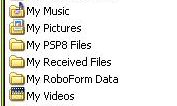
Lets start with some background info. There are a set of special folders in My Documents that have a Special Folder Icon (see screenshot) like My Music or My Pictures.


There are 2 ways to move your My Documents folder:

For Multi-User system (more that one user logs on)

Any user can drag-drop their My Documents folder from C: to D:
  1. In Explorer (aka My Computer) find your My Documents folder (in C:\Documents and Settings\your-profile-name)

  2. Open another Explorer window on D:

  3. Now drag your My Documents folder from C: to D:

You SHOULD get a set of folders in D:, here's where those Special Folder Icons come in.

For user John Doe, you something like:
  • John Doe's Documents
  • John Doe's Pictures

The same happens for any other user that is logged-on and moves their My Documents folder, but with their logon name.


Single-User system

Here is how I moved the My Documents folder on my home system

ORDER OF STEPS IS IMPORTANT

  1. Created D:\My Documents

  2. COPIED the full contents of C:\Documents and Settings\my-profile-name\My Documents to D:\My Documents, DO NOT DRAG/DROP

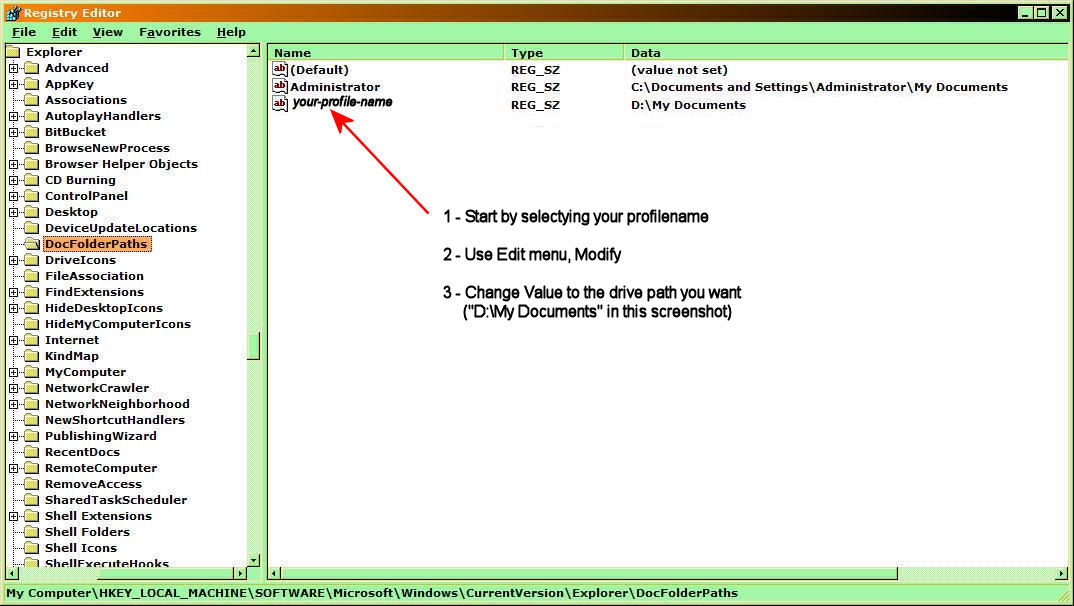
  3. IMPORTANT - use the Registry Editor to change my Document Path (see screenshot)


  4. (click for readable view)


  5. REBOOT

Regardless of which method you use, you now should test to see if it worked.
  1. Click [Start], Documents to open your My Documents folder

  2. Now find a simple file you saved before (suggest a text file) and open it

  3. Now use the File menu, Save As, and rename the file (example MyDocsPathTest.txt), save

If things went correctly, the MyDocsPathTest.txt should be in D:\My Documents but NOT in C:\....\My Documents.

At this point you can delete the contents of C:\....\My Documents, OR the entire folder. In my home system I deleted the My Documents on C:

Wednesday, November 3, 2010

SECURITY - Courier CD

Where I work (IT Tech) our software engineers have to transport classified code to/from customers, and using USB drives is not authorized. A solution was agreed to by a customer, one that is simple and does not require expensive software.

When I became aware of the method used I thought that this could be used by anyone who wishes to transport any data files on a CD.

Courier CD System:

The first requirement is to have a good ZIP utility (like WinZIP) that is capable of password protection of ZIPed files.

To create a Courier CD

  1. ZIP your files into a first file, and give it a filename that does not reveal what it contains

  2. Example: container.zip

  3. ZIP container.zip into a second file, with password protection

  4. Example: wrapper.zip

  5. Now write wrapper.zip to a CD

Why the double ZIP?

When you ZIP a set of files with a password, anyone with a ZIP utility can see the directory of the contents. They just cannot extract the files without the password. The double ZIP will allow only (in this example) wrapper.zip to be seen.

Now you can transport the Courier CD without the worry that the files can be compromised if you loose the CD.